Pedrocchi Coffee
Our local guide Chiara introduced us to a rather unique cup of coffee at Padua’s oldest café, Pedrocchi. Having first opened its doors in 1831, the building has been designed in the shape of a piano – homage to the Paduan inventor of the pianoforte, Bartolomeo Cristofori. The interior has a rather imperial look about it with its high ceilings, marble walls, columns and counters, and wood-and-velvet furniture. Yet, somehow, it seems to have kept up with the times, too.
Apart from the rich Italian and European history that Café Pedrocchi has witnessed and survived over nearly two centuries, the café is also quite popular for its namesake coffee – Caffè Pedrocchi, which they claim to be the most famous mint coffee in the world. It is composed of a warm Arabica espresso base, topped with cool fresh cream and mint syrup, with a dusting of bitter cocoa powder. The idea is not to stir before consumption, and to allow the warm and cold, bitter and sweet to combine naturally on the palate. It’s an interesting, bitter-sweet combination that progresses from visual to olfactory to gustatory sensations. Priced at EUR 6,00, it definitely makes for a fun and memorable culinary experience.

Pizza
You’re in Italy. You’d expect to find a pizza parlour at the corner of every street, correct? Wrong. That might be the case in Rome, but not in Padua. In fact, we only had pizza once during our stay. But that once was pretty good, because Forbici Pizza Crunch had a great selection of toppings that, at least to us, were partly unconventional. So, we went all out and tried five types. To be fair, the bread was thin and light, so we could afford to try a few toppings without exploding on site.
The picture below shows (top L-R) Diavola – a slightly spicy sausage with gooey cheese and tomato, Romana – a bit like a margherita, (bottom L-R) Carbonara – bacon, cheese and egg, Patate Sfoglia Pesto Genovese – puffed potato and Genovese pesto, Ricotta Melanzane Mortadella – mortadella and ricotta with eggplant and pistachio. They were all great, and I thought the last two varieties mentioned were quite interesting for their somewhat novel ingredients – potato, and then eggplant with pistachio. They tasted great, too. Enjoyed a seemingly simple but very satisfying lunch.

Sfogliatine Glassatane
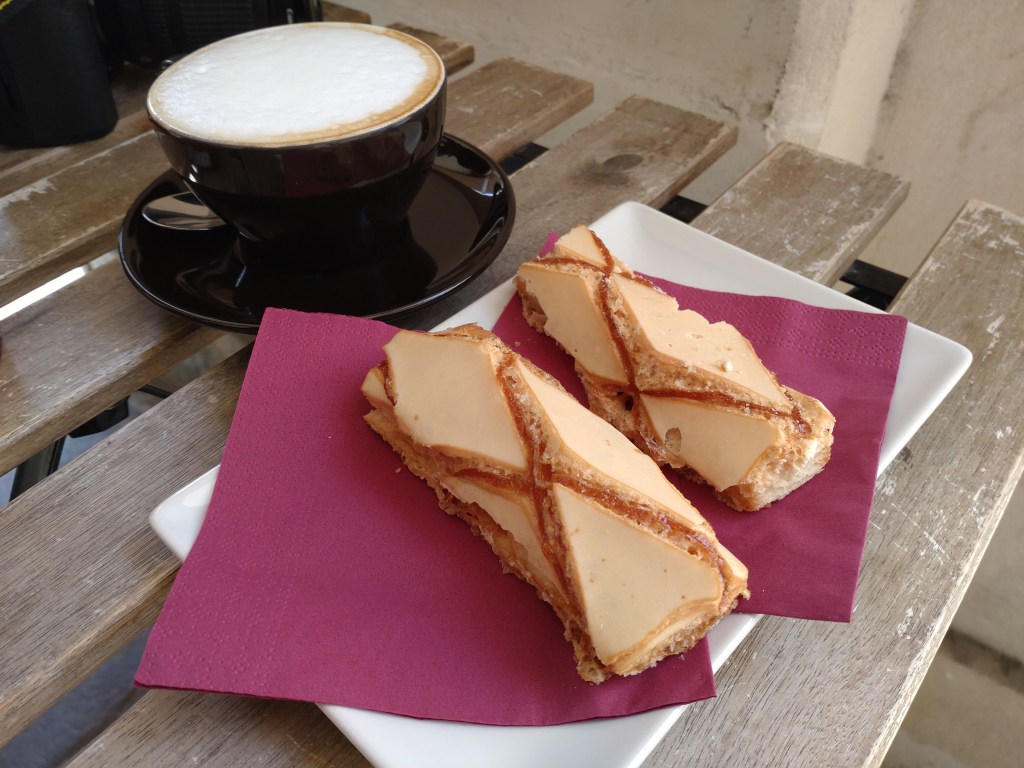
We made a stop at a little café on one of our walks for a cuppa (cappuccino, of course), and saw these delightful treats in a jar on the counter. Sfogliatine glassatane, which translates to “glazed sweets, is an Italian cookie, so to say, made from pastry sheets, sugar and egg white. They are glazed with jam – usually apricot – and baked to crisp perfection. The end result is a very light sweet snack that has a bit of toffee-like stickiness that comes from the baked jam. As I bit into my sfogliatine, I realised that I’ve had this before (cannot recall when and where) and had a nostalgic impulse of a taste that I had truly enjoyed. And so, I enjoyed this little delight once again with a smile.
Cannoli
I believe it was almost exactly ten years ago, while we were visiting Assisi, that I learnt how great a friend a cannoli could be. Perhaps not for one’s blood glucose levels, but for one’s dopamine levels. With that memory in mind, I was keen to have a cannoli while we were visiting Padua. This time, we went with the mini version at Caffè Diemme which, for its small size, had an impressive display of sweet treats and other snacks to choose from. I have to admit here that I might have picked the mini version because I wanted to try the cute mini hazelnut tart (which, by the way, was SO good) as well. The cannoli was lovely, as expected, with its hard shell, inner chocolate lining, soft cream and a bit of pistachio. Little joys that create lasting memories!

Creamed Cod and Polenta
As I mentioned in my previous post on Ristorante Antico Brolo, creamed cod and polenta are very popular traditional dishes in the north of Italy that you’re bound to find at most restaurants in and around Padua. Follow the link above for more information on it.
 The Eat Log